The Ralph Loop is Now Basically a Fixed-Point Process
When the Ralph Loop went viral back in January, it was framed primarily as a way to brute-force Claude Code through tough, complex feature implementations — just keep feeding the agent the same prompt until it bangs out the feature. With this framing the criticism from some was fair: it looked like a way of avoiding careful thinking, substituting token spend for judgment, and hoping the model would eventually stumble into correctness. And with the models available at the time, that criticism had teeth — they genuinely were too unreliable for this kind of unsupervised iteration to work consistently.
But models have gotten meaningfully stronger since January. Today, for moderate feature complexity, the Ralph Loop does generally work. But it's actually much easier to see it working — and to trust it — when you apply the same iterative pattern to simpler, more on-rails tasks like plan refinement, prototype validation, and implementation verification. These are far less token-heavy and converge far more reliably.
For well-defined tasks like these — the kind with a clear reference and a clear completion condition — current agents are powerful enough to function as genuine fixed-point operators, even with their native stochasticity. And the Ralph Loop — roughly speaking — has become a fixed-point process.
The clearest and fastest place to see this is not in feature implementation, but in plan refinement.
Anyone who has used Claude Code's plan mode knows the experience: you describe a feature, Claude elaborates it, and somewhere in that conversation an edge case surfaces that you hadn't considered. The plan gets richer. Then the session ends.
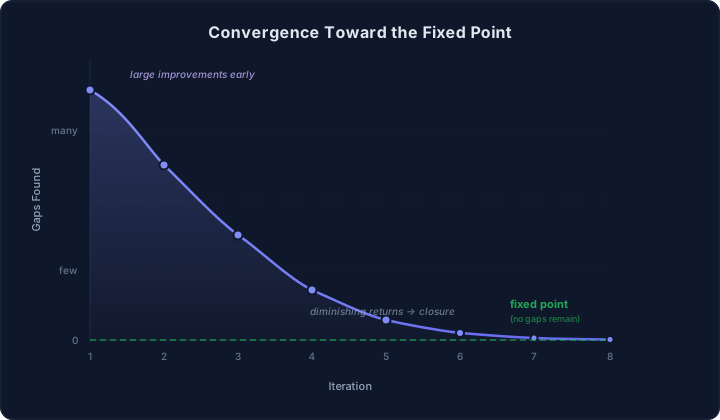
But think of that as just the N=1 iteration. If you haven't tried running the same kind of pass two, three, even five or ten times manually — you should. In my experience, each successive pass continues to squeeze out value: missed edge cases, implicit assumptions, gaps you couldn't see until the previous round's fixes revealed them. The benefits taper off eventually, but not as quickly as you'd expect.
And with a little guidance — a consistent prompt directing the agent to look for gaps, coverage misses, and edge cases — an agent like Claude can perform this iteration on its own.
The Ralph Loop automates exactly this. Each iteration, the agent reads the current plan and a prompt asking it to find gaps, logical inconsistencies, and unconsidered edge cases. It makes improvements, records what changed, and exits. The next iteration finds what the previous one missed — not because the agent failed, but because at iteration n, the n−1 preceding refinements have been made, and new gaps are now visible that weren't before. The stochasticity of the model, combined with the accumulating context of prior work, reliably surfaces things a single pass would not.
The loop terminates when a full pass finds nothing to improve. That is the fixed point — a plan that is internally complete, consistent, and closed against the original intent. And it is cheap: no code, no running system, just a document converging toward completeness before a single line is written.
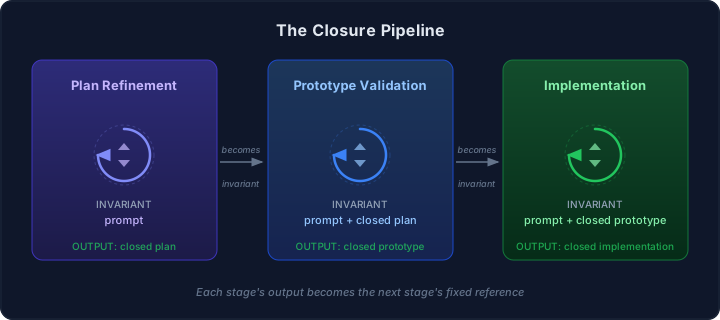
This is one stage of a broader pipeline. A closed plan becomes the invariant for the next stage — building a prototype — where the loop checks that every design element and feature of the plan is faithfully present in the prototype. A closed prototype becomes the invariant for implementation. At each stage, the same fixed-point structure applies: a stable reference, a repeated checking rule, and a semantic completion condition.
For these kinds of well-defined, on-rails tasks, agents like Claude and Codex are now functioning as fixed-point operators — stochastic as they remain for open-ended work, they are reliable enough for structured closure tasks to converge. Define your invariants, apply the operator recursively, and after enough iterations you reach a mathematical closure — a state where a full pass produces nothing new.
This pattern — a fixed reference, a repeated checking process, convergence toward completeness — has a very clean analog in mathematics. Understanding it clarifies not just why the Ralph Loop works in these scenarios, but when it will and won't converge, and how to structure the inputs so that it does.
A fixed point is a state that a process leaves unchanged — apply the rule, and you get back what you started with. Closure is the state you converge toward by repeatedly applying a rule until nothing new is produced.
A classic example: given the rule "if A knows B and B knows C, then A knows C" — start with Alice → Bob, Bob → Carol. Apply the rule: Alice now knows Carol. Apply it again: nothing new. The system has reached closure — the smallest complete state reachable by repeated application of the rule. Every chain has been followed. Nothing remains unresolved.
This structure appears wherever you have a reference and want to ensure something else fully corresponds to it. A plan and a prototype. A prototype and an implementation. A specification and a test suite. In each case, the reference is the invariant, the checking rule is applied repeatedly, and the process terminates when a full pass produces nothing new — when closure is reached.
In each of the practical Ralph Loop closure scenarios above, the invariants are different:
- Plan refinement: The invariant is the prompt itself — a directive to find gaps, inconsistencies, and unconsidered edge cases. It operates on an initial plan, building it out iteration by iteration until a full pass finds nothing to improve.
- Plan → prototype: The invariants are both the prompt and the completed plan. They don't change. The prototype is the thing converging — assembled step by step until it faithfully represents every element of the plan.
- Prototype → implementation: The invariants are the prompt and the completed prototype. The implementation converges toward it in the same way.
At each stage the agent acts as a semantic closure operator — stochastic, yes, but powerful enough to repeatedly compare work against a fixed reference and close the gaps it finds.